On my own site I write that I don't fall in love with ideas, I fall in love with problems. Techstars Startup Weekend Porto put that sentence to the test. For the first few hours, I failed it.
54 hours that felt like a startup life cycle
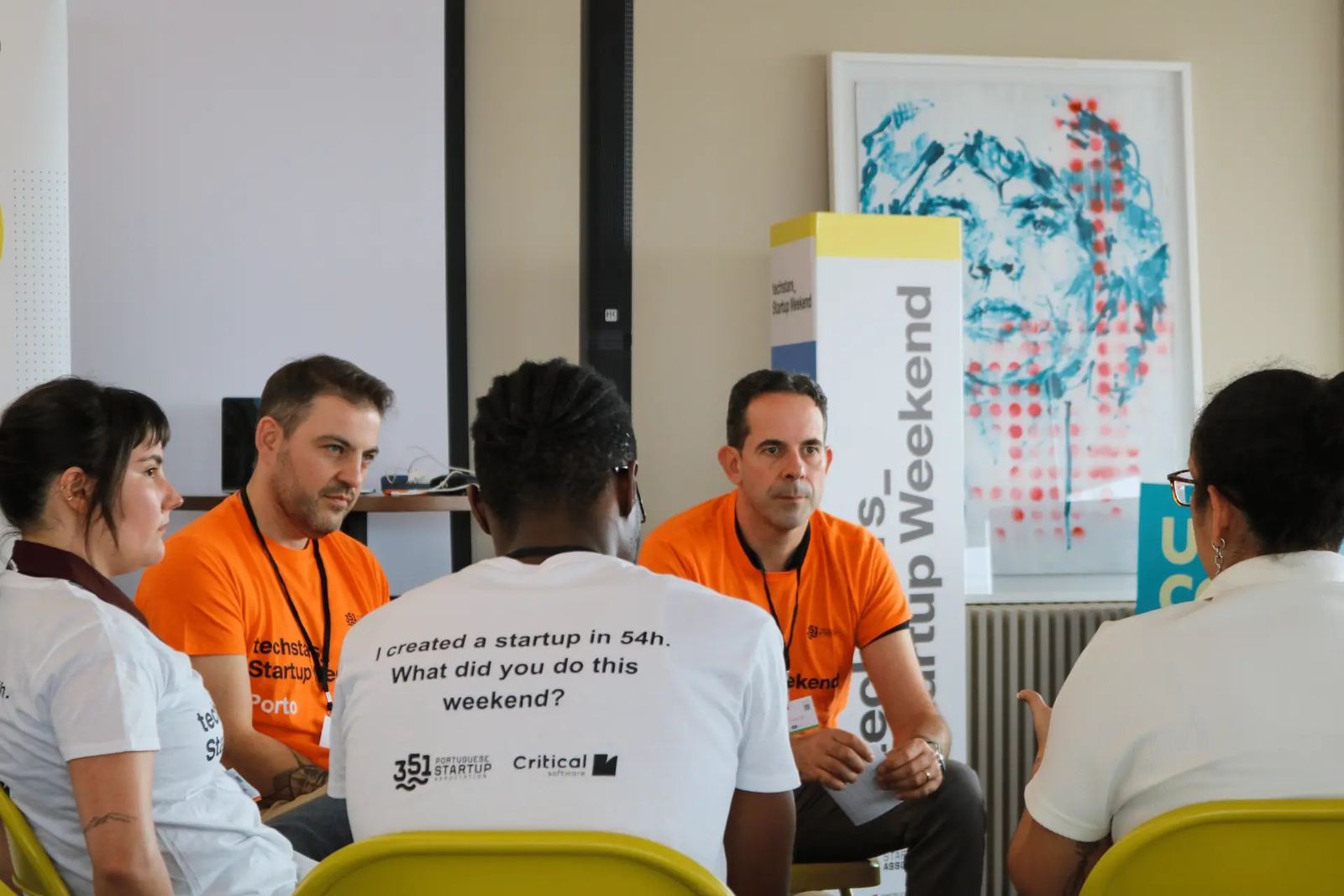
Startup Weekend Porto is organised by 351 Portuguese Startup Association with Techstars. The format is easy to describe and hard to live. It runs over three days. On Friday night, anyone can pitch an idea in one minute. There were 16 pitches. Teams form around a few of them, and on Sunday evening each team presents a startup to a panel of judges. Four startups came out of this edition, and 18 of us stayed for the full 54 hours.
54 hours sounds like a weekend. It felt more like a compressed startup life cycle: idea, team, problem, validation, prototype, business model, pitch. There was no time to hide behind planning.
The idea I didn't buy
I joined a team working on a community for women's safety. I was the CTO, and the only man on the team.
I'll be honest about where I started. My personal sense of danger is fairly low. When we began, my first thought was: WhatsApp already shares location. Google Maps does too. Apple has Check In. There are safety apps. Is this really a problem that needs another solution?
It was a fair question. But I was answering it with the wrong evidence: my own experience.
What listening changed
My teammates talked about completely ordinary moments. Walking home. Going out alone. Meeting someone new. Sharing a location, or telling someone where you are. Deciding, in a few seconds, whether a situation feels safe. Wanting someone nearby.
None of this belongs only to women. Feeling vulnerable is human. What changed for me was seeing that the frequency, the context and the way these moments are lived can be very different.
I didn't feel those situations the same way. That didn't make the problem less real. It meant I was the wrong person to rule it out without looking closer.
That was the uncomfortable part. I like to think I start close to the problem. Here, I was the person furthest from it, and I had been the quickest to judge it.
Looking before building
So we didn't start by building. We questioned the idea first.
We also talked to women outside the team, so we weren't relying only on our own view. On Saturday, the second of the three days, we reached out beyond our own circle and asked about the same everyday moments my teammates had described.
In less than 24 hours, almost 30 women replied. Around 90% said they recognised themselves in the problem. Some went further: they told us they wanted a tool like this, and that they would be willing to pay for it.
That was the moment the weekend changed for me. A few hours earlier, I had been the sceptic in the room. Now the people who live the problem were answering the question I had been asking, and their answer wasn't mine.
I want to be careful about what this means. Almost 30 replies in a day is not a market study, and saying you would pay is not the same as paying. But it was real evidence, from people outside our team, and it was strong enough to validate the thesis we were building on. The need wasn't something we had imagined around a table. It was something other people recognised in their own lives.
It also changed what I think validation looks like. Before that weekend, I would have said it takes weeks. We had a clear first signal in less than a day, because we stopped debating among ourselves and asked the people who live the problem a simple question.
At the same time, we mapped what already existed. We didn't find that nobody solves this. Several tools solve parts of it well: sharing a location, checking in, calling for help. But the experience is spread across them. We saw an opportunity to bring it together around a community, and that became BetweenUs.
Only then did the solution start to make sense. Not because we liked it more, but because we understood the problem better.
Mentors who made us think
The mentors questioned our problem, our positioning and our business model, and pushed the pitch until it was clearer. They didn't build BetweenUs. We did. They made us think better while we did it. Honest feedback from people who have been through different stages of building companies is something I want much more of.
On Sunday, we presented BetweenUs to the judges. By then, it was no longer an idea I doubted. It was a hypothesis we could defend, backed by the people we had listened to.
People, not just product
One of my biggest takeaways wasn't what we built, but who I met while building it: founders, mentors, judges, facilitators and people from Portugal's startup ecosystem. Some conversations brought a question I hadn't asked. Others brought a critique I needed. I don't know which will turn into something more, and that's fine. Startups are built with products, but also with people.
And then there's the team. I thought I'd bring my experience to them. I learned far more from theirs.
What I'm taking with me
The most important thing we built that weekend wasn't BetweenUs. It was a better way of thinking about problems. I'm bringing these questions back to Flix Home, where I'm talking with property managers about how they keep track of their portfolios, and to whatever I build next:
- Before building: what is the problem, really?
- Before writing code: who lives it, and how differently from me?
- Before defining the solution: how do they solve it today?
- Before assuming the idea is good: what evidence do we have, apart from my opinion?
- Before scaling: can we prove someone actually wants this?
"Fall in love with the problem before the solution" sounds easy. This weekend taught me the harder half: sometimes the first thing standing between you and the problem is your own experience. And the fastest way past it is to ask the people who live it.
Thank you to Beatriz, Luisa, Cristiana and Joana, to the 351 team, and to every mentor and judge who asked us hard questions.